Saturday, October 21, 2017

outdoor classroom 10-16-17

On Monday, the children eagerly ventured into the woods - excited for our outdoor classroom. Some Kindergarteners wondered about the note they had left for the fairies the previous week, will the note still be there? Did the fairies visit? Many Kindergarteners hoped to add on to their large and small structures, discussing the sticks they may find. There was - as there always is - a sense of joy and wonder as we stepped over and around the roots and rocks leading to our outdoor space.


 ZM finds the longest sticks to add to her fort. Watch, she calls, as she slowly lifts a heavy branch. She takes one careful step after another across the pine needles, exclaiming, I'm SO strong!


IM and ML look for the note they had left for the fairies. The paper and cardboard are found on the edge of the woods, near the entrance to our space. We all wonder, did a fairy move the note?

How do you know if a fairy has been here? - CS

You know a fairy has been here if you find gold, we have to look for gold dust. - IM

We should write another note and ask for their name! - IM


Welcome Fairies.
Do not touch.
Sign your name, please. 


TW rushes through the woods, stopping to pick up a notebook. His body is suddenly still, except for the motion of his hand across the paper. It is important to offer and encourage a variety of experiences in our outdoor space, bringing paper, pencils, and crayons supports children's interest in writing and drawing what they see, experience, and feel within the woods - representation becomes part of their play and exploration. Next week, I will introduce outdoor classroom journals for each child to have.

Sunday, October 15, 2017

the writing workshop

The Kindergarteners have been writing in many different ways since the very beginning of school. They have created an extensive library of little books about Fall and leaves. All have responded to prompts through our morning message and community building work. Many have started to create books about the letters we're learning. It has been powerful to observe and be a part of. These moments have reminded me of an important concept; children bring the colors, life, and stories to the classroom. Literacy is part of all that we do and can be supported and encouraged in meaningful and rich ways.

That being said, this past week I introduced the writing workshop - following the model of a mini lesson, teaching point, and independent work time. As with all learning experiences, the share at the end of the workshop was incredibly important. There are helpful and relevant lessons and examples in the program that we use, but for me the most important parts of writing in Kindergarten are to nurture a love for stories and representation, to develop a culture of storytelling, and to encourage children to recognize the power in their voice and in their words. What they have to say is important and they can make an impact on our world.

Throughout the year we have recognized the different kinds of books we read and the authors and illustrators of these books. For the beginning of our writing workshop, the children dive deep into writing teaching books - teaching their audience about something that they know a lot about.


AM shares her writing about horses, teaching us about the different things horses like to eat and play.


The following day, the children illustrated a cover for their writing folders. I modeled and we practiced putting work in the pockets of a folder - ensuring that work does not get crumbled or bent. The children were careful and slowly slid their work inside their folder.

When you walk with your writing folder, you make sure your pockets are down, so that your writing doesn't slide out. Writers and readers always hold their work upright and in the correct direction. The children's covers were so unique and a wonderful representation of their humor and interests. Over the weekend, I have attached their covers to the front of their plastic blue writing folders - this year's home for all of their powerful work.


"This is me with trees. I'm wearing a blue shirt, because I love it. I'm also wearing a little party hat on my head!" - TJ


"I drew a pencil, because we write with pencils" - EO

a glimpse into choice


We have been exploring the colors of Fall through read alouds, the making of books, and our experiences with natural materials. On Friday, some children worked on a special canvas - coffee filters. They first covered their uniquely shaped canvases with red, orange, purple, and yellow ink. Once covered, the artists added water. Each final piece was a blended representation of the colors found in our woods and fields.


Small Construction;

The Kindergarteners continue to build bridges using rocks, stones, corks, buttons, and bark. While building bridges they are testing and exploring balance and weight. They turn and stack the rocks and wooden rods in different ways and directions, constructing from their unique plans.


The Share; 

IM explains the details of her bridge and the materials used to construct her work. Later, she draws and labels an image of her bridge. She stretches the word bridge and writes the corresponding letters. The focus isn't about conventional spelling, but hearing for letter sounds. Her perspective was looking down. Knowing the materials used in her work, I wonder what her drawing would look like from the side? I wonder if she could recreate the structure from her drawing? What other labels would she need to support her (or a peer) in rebuilding her structure? I plan to put their drawings together, creating a small book of bridges to keep in our science space. These drawings by the children along with photographs will be a way to revisit, reflect and recreate.


TJ notices the lines of his bridge, one straight down and one across - again, a reference to a t is made. His bridge has a collection of rods underneath, providing support.


Saturday, October 14, 2017

nurturing literacy 10.9 - 10.13

Each day is rich with opportunities for the Kindergarteners to engage with print - through our morning message work, the reading of our schedule, the reviewing of classroom signs, read alouds and the sharing of books. The sharing of work provides yet another way to integrate authentic language learning - encouraged and inspired by the children's interests.

Morning Message Noticings

Our morning message work provides a daily invitation for the Kindergarteners to circle a noticing. Perhaps it is a known letter or word. Sometimes it is a deeper investigation into a new word. In the following photographs, JF notices the word is. He finds, reads and circles the word. We talk about how the word is will always be in our message and can be found in many of our books. 


Thinking about Characters

In the below message, we reflected as a whole group about the character Lilly from the story Chester's Way written by Kevin Henkes. One child shared, Lilly is a storybook character - not a real character. Their peer responded with, She isn't real, but she wears costumes and carries a squirt gun in her back pocket! She is silly! One final reflection helped all of the Kindergarteners to think deeply about an essential character quality -

Lilly has a mind of her own!

Our conversation about the character Lilly prepared the children for the following read aloud - Lilly's purple plastic purse.


Asking and Answering Questions

Connecting a new morning greeting to a question for the class - Do you like to jump? We first talked about the number of parts in the word jump, what letter the word starts with, and how many letters. The Kindergarteners answered the question, counted and compared how many. It was a meaningful and exciting way for the children to engage with our morning message. 


Transitions - a social experience!

The Kindergarteners engage in independent and partner reading during transitions from snack and work time. It is often the most authentic and engaged reading that I observe and hear. Children find their favorite books to reread, inviting their peers to read with them. 


Name Stamps

The children are excited to explore their own name as well as the names of their peers. We make connections between the letters in our names and the letters we are learning. When there is a C at the beginning of a word, many of the children will say, "There is a C like in your name, Cassidy!" 

Name stamps are a way to honor the interest and excitement about names while building foundational literacy knowledge. 


Saturday, October 7, 2017

academic choice - a time to empower and inspire

Two of the recent experiences during choice have been using stamps and black pens to make leaf prints and using a variety of materials to represent fall. The children have eagerly engaged with both experiences, their work detailed and purposeful. Last week, one child began to develop a leaf book. I asked this child to share her work with her peers.

It took one child's interest to encourage and excite the entire community. Suddenly, many children wanted to make little leaf books or books about fall. As always, it is these moments that are authentic and meaningful. The curriculum carefully and thoughtfully developed as the students and teachers engage in a rich, challenging, and authentic back and forth. The teaching and learning are interactive and ongoing.

Leaf Books;

Listening for letter sounds.
Stretching words.
Writing sentences.


Writing Fall Books;


The Share;

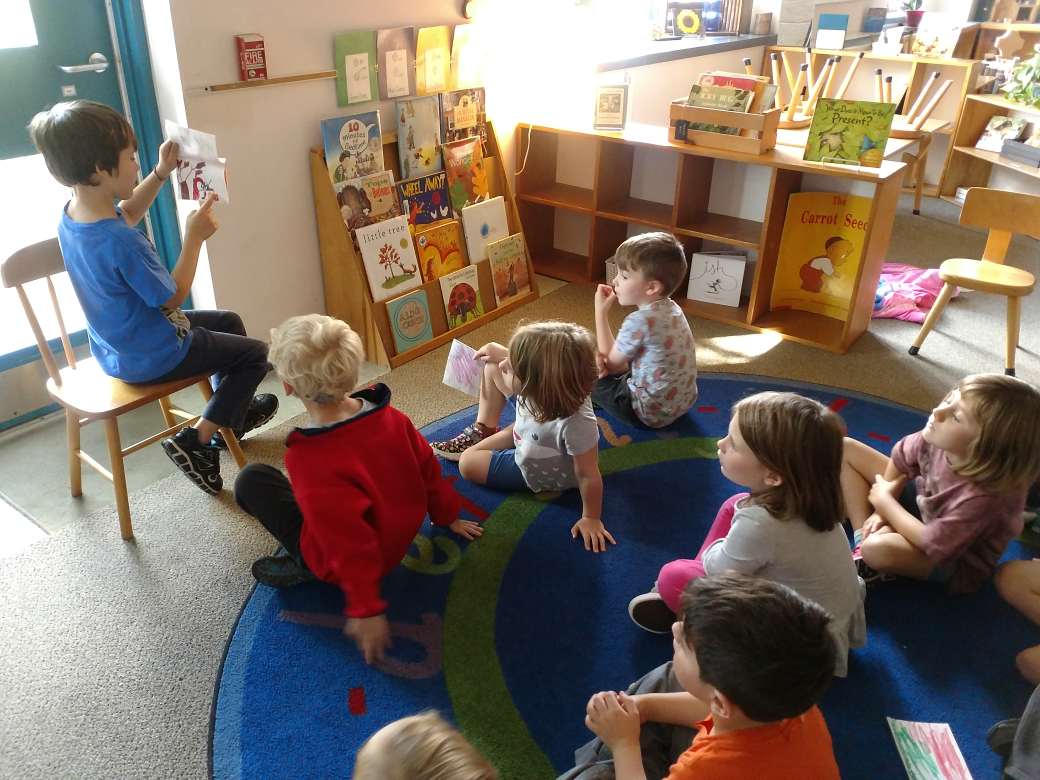
An opportunity for the authors to share their work with their peers and for their peers to ask questions or provide comments. The share is also an opportunity to empower and inspire!


Small Building;

Every structure has a story!


Dot Letters;

Our new community member had the opportunity to engage and explore during afternoon choice this week. The children have been incredibly welcoming and supportive of their new peer, inviting CB to join their play and following CB's lead in dramatic play, storytelling, and games. On Friday, CB was eager to share his dot letter work with his community, calling on two friends to offer comments. When calling on ML, he asked her to join him in front of the class - she happily and warmly accepted.