Saturday, February 3, 2018

true story - ski and ride!

Throughout the year we engage in opportunities for shared writing. This could be a letter to someone, the writing of a how-to book, or the telling of a true story. Ski and Ride has provided an incredible opportunity to reflect on and tell about a shared experience! 

On Wednesday we worked together to tell the outline of our Ski and Ride adventure. Using transitional words, children talked about our time together. We practiced telling about Ski and Ride orally, planning across four pages, and then writing the words. As I wrote the children's words on large chart paper, they helped to stretch out words and reminded me of using my sight word power

With whiteboard in hand, each Kindergartener provided illustrations and words for our book. We talked about detail, labels, speech bubbles, action, and making our readers feel like they were there with us. There is a lot of humor in our story, because outside of the context of the rental shop, we can all laugh at how busy it is. The children said, The rental shop is craze (crazy).


Ski and Ride

By - The Kindergarteners

1. First we got on the bus! We were excited. We were going to Smuggs.


2. Then we got to the rental shop. It was busy and a little crazy!


3. Finally we went to our lessons. We learned SO much. We had fun!


4. Then we went to lunch. We were tired, hungry, and happy.


the giving tree

On Monday we continued our ongoing conversations about kindness, extending the idea that the choices we make can impact our community in powerful ways. Our reading of The Giving Tree encouraged deeper thinking and learning about being together.

I wanted one part of our book reflection to be open ended; How did the book make you feel?

Many Kindergarteners talked about feeling sad for the tree, some said the boy was mean, many noticed that the tree gave and gave but the boy was never happy. As an adult, perhaps The Giving Tree makes us think about the challenges of life as we grow. The children noted this challenge as well, this push to acquire more, but feeling a sense of loss. Not all of the books we read to children should evoke feelings of joy. We learn about ourselves and our world when we have the opportunity to be in a place of confusion, wonder, upset, sadness, or loss.

The Giving Tree can be interrpeted in various ways. Of course, we scaffold conversations by asking specific questions or proving prompts. My hope for our conversation was for children to recognize the power in giving love and what that looks like in our community. Asking the question, What will you give today? 

We revisited small acts of kindness, recognizing the power in giving a smile, laughter, happiness, love, or a hug. If we all give little things, will something bigger happen? If we all work together, could we be a giving forest?

I introduced the book through our morning message, integrating some math work into the introduction. We then read the book and thought about what we will give. TW wrote our question, What will you give today? The children used small pieces of paper to write their name and thought. With our own giving tree in the center of the oval rug, each child used a small pin to attach their plan. Now, our beautiful giving tree lives outside of our classroom door.

We invite you to think about what you will give today and share it on our tree!


Through this community work, children answered a question by adding their name to a t-chart. We then investigated our data by counting and comparing how many had read The Giving Tree. The children engaged in thoughtful book reflection, actively making connections. Children were asked their idea before putting it on paper, supporting the concept of planning before you write. The Kindergarteners stretched out words and added them to our tree, some children wrote sight words, such as love.

We further extended our book connections, by reading a true story about peace and hope; Wangari's Trees of Peace. OM said this nonfiction text reminded him of The Giving Tree, because both books are about what trees can give. This was a powerful read aloud, as trees are a symbol of life and hope. The children have been writing true stories and I have been integrating the reading, hearing, and telling of true stories throughout our work.


Sunday, January 28, 2018

math journals

The Kindergarteners have been working in their math journals throughout the year, solving word or story problems using a variety of developing strategies. Their journal work encourages the use of creative thinking and problem solving skills, while challenging them to show their thinking. Children are using various counting strategies to solve a problem, exploring ways to make and show numbers and amounts, solving missing addends, and organizing and representing their thinking in a way they can read and talk about.

When introducing or sharing about a problem, we reflect on the many different ways to solve a problem. I often ask, did anyone solve it a different way? The journal share offers inspiration and ideas. When looking through their journals, we have frequent check-ins about providing labels and ensuring organized work.

I believe math journals to be an essential part of the children's learning. While I appreciate the convenience of a workbook, I like to write our own story problems - connecting the problems to learning across contexts. For example, at the beginning of the year our focus was on community and learning about the children in our class. When introducing our math journals, the first problem was, how many friends in our community? Now, to connect our journal work to our math calendar, children have been solving button problems. It's always fun to use a Kindergartener's name in our story problems, offering a bit of ownership.

The Button Problem - solving the missing number!

The button problems have supported children's knowledge of combinations to five and recognizing these combinations quickly. At the end of Kindergarten, children should be able to consistently decompose five and ten into different parts. All of these problems support children in thinking about number combinations in different ways, supporting deeper thinking and understanding.


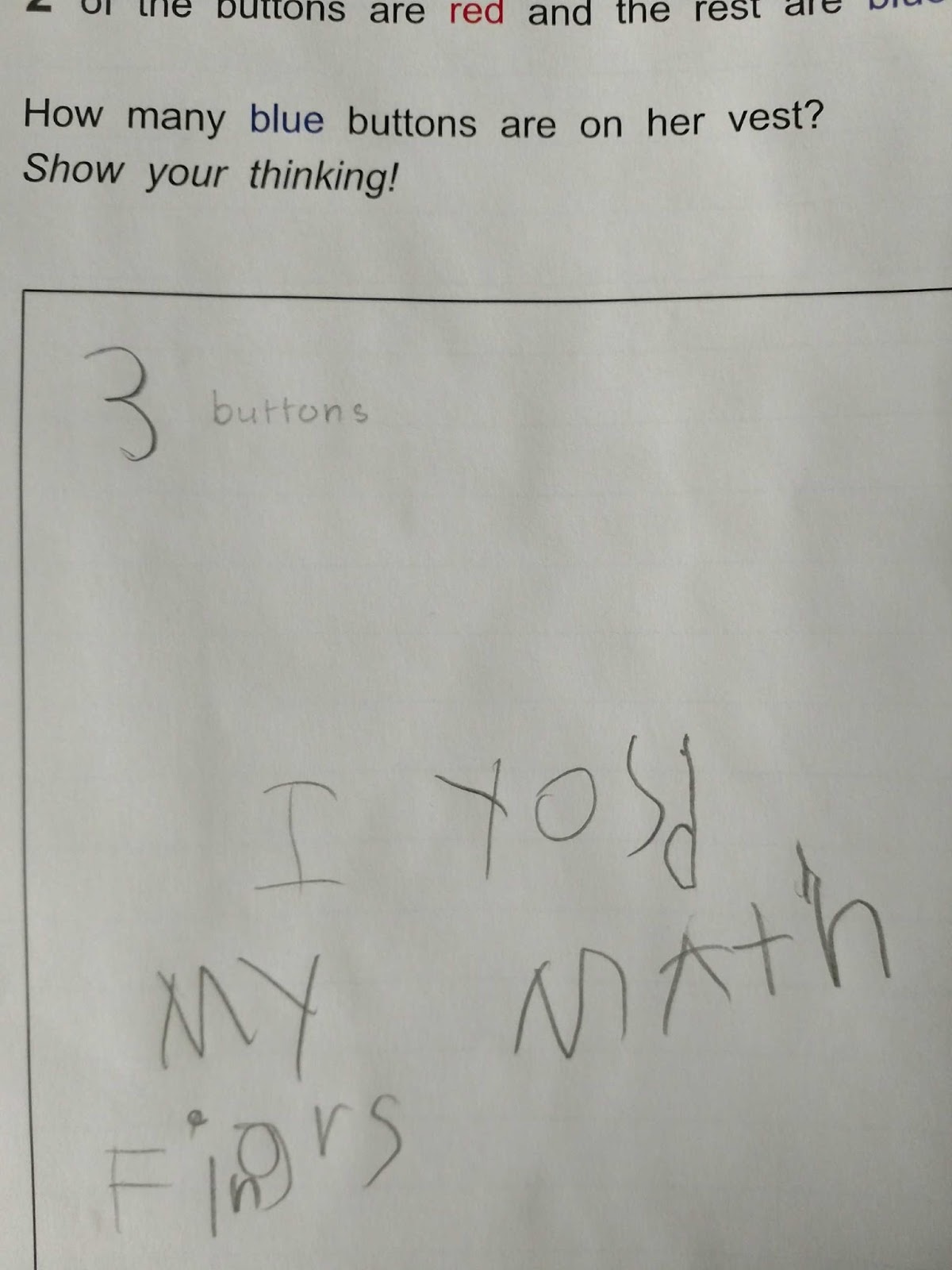
Anna has 5 buttons on her vest.
2 of the buttons are red and the rest are blue.
How many buttons are blue?

In the first image, the student knows their combinations to five. When presented in a different way, she is able to solve the missing number using what she knows about five. When I asked her how she would show that, she talked about checking her work. Through our journal work, another important teaching point is mathematician always check their work! Knowing this mathematician, a next step would be; Can you show this problem using a number sentence (equation)? Can you show this problem using a number tree?

In the second image, the student used a picture to determine how many buttons on Anna's vest, they then further explained in writing, "I read some of the words and I counted 5. 3 buttons". The student made sure they had five buttons total and that only three of the buttons were blue.

In the third image, the student used a frame to show their thinking. When sharing her work, a peer noted her five frame actually had 6 squares. Together, we drew another five frame. Again, the share is a second or third opportunity to reread and check your work!


For the next journaling experience, I offered two different button problems. In one, I flipped the numbers and used different colors - would they be able to solve it quickly and independently? In Kindergarten, it is often surprising how changing the colors in a story problem can cause a bit of chaos! This time, three of the buttons are purple and the rest are green. How many buttons are green?

I was surprised that no student working on this problem made the connection to the previous button problem. In retrospect, I also didn't ask if anyone noticed what was the same or different about the two problems. Perhaps we will go back as a whole class and ask the question.

I have noticed that the more often we look at our work as a community, the more children notice. We discuss how mathematicians all over the world keep journals and how important this work is - important work means you take care of your journal. Children are proud to provide neat and organized work.


During this time, I also offered a button combination challenge to a large group of students. These students can consistently decompose five quickly, but can they figure out how many button combinations?


Inez has 5 buttons on her vest.
Some are purple and some are green.
How many different combinations could she make?


In the first image, I asked, "Can you tell me how you solved this?"
The student responded with, "I thought about it". Ah, yes, spoken like a true mathematician. Notice how our conversation led to checking her work and crossing out two extra combinations. A next step for this student would be; Can you write an equation to show each button combination?


In the below image another Kindergartener used a picture to show how they solved the button combination problem. When they wrote the number six, I asked, "Six what?" She wrote, "BC" for button combinations.


Again, another student used a picture to solve and show how they solved the problem. I wonder, is there another way to solve this problem?


Sometimes, I take a math question from the morning message and put it in each of their journals with their answer. On January 25, I asked, Can you show 25?

When looking at their collective work, Kindergarteners put a hand up to share their noticings;

I notice that we showed 25 in different ways.
I notice some friends wrote 15 instead of 25.
I notice some people wrote 25 lots of times on their sticky note, that's confusing. Should we just write it once?
I notice everyone did it!


AM uses the 100's chart to record the number 25.  I believe a mathematician must use their environment in addition to their knowledge to solve a problem. AM was able to independently solve two problems - the expected problem of showing 25 and the unexpected problem of not being sure how to print 25!

Saturday, January 27, 2018

ski and ride


a line of skiers return to the magic carpet
1-26-18


We happily embraced the bright sunshine and blue sky on Friday. All Kindergarteners worked hard on their developing skills! OM and ZM took a quick snack break in the snow while CB skied on.

A group of beginning skiers practiced their turning and stopping at the base of Sir Henry - balance continues to be an important part of all of their work!

kindness

1-24-18

Middle school students visited our classroom on Wednesday afternoon as part of our school's celebration of kindness. With a book about kindness in hand, each student read to a small group of Kindergarteners. The children were delighted and eagerly listened to the stories. We returned their small act of kindness with one of our own - sharing our community snack with them. 

It is incredibly powerful to observe some of the oldest and some of the youngest students in our school coming together in authentic and meaningful ways. When we think about embracing a whole school community, we must offer little moments like these - students reading, reflecting, and playing together. We must always recognize and encourage small acts of kindness. We must offer time for students to come together, to share a snack or a silly story. During conversation, one middle school student said that her favorite part of Kindergarten was playing during choice time, immediately all Kindergarteners did the silent connection symbol!


Why is it important to be kind?

IM - Because then the people you are kind to will be kind back to you.

TW - Because it feels happy to be kind, like, I feel happy when I am kind to my mom, dad, Manny and Rosie. I love them.

ML - It's important to be kind, because you can spread kindness.

AR - I agree, if you are kind, they will be kind back!

How will you be kind today?

JF - I'm going to be in the green zone.

EO - Push in chairs.

CM - Help wash the tables.

OC - I'm going to clean up the loose blocks in the block area.