Saturday, October 7, 2017

sentence building

Monday, 10-2-17

Words have letters. 
Sentences have words.

We have been reading books about Fall and leaves. The children have been representing leaves during choice, finding leaves in the natural world, and writing their own little books about leaves. Connecting our work with leaves to our work during Fundations, I wrote four sentences on large chart paper, providing specific colors and illustrations. I shared the sentences with the children.

I see a red leaf.

I see a brown leaf.

I see a yellow leaf.

I see leaves.

We talked about what a sentence is and what many children already know about sentences. A sentence has words and starts with an uppercase (or BIG) letter. A sentence ends with punctuation, these sentences end with a period. The children noticed what was the same and different about the sentences. They found the letters we've been learning. We then read the sentences together, carefully pointing to each word as we read.

Another way we learn about sentences in Kindergarten is building sentences. Following our choral reading, I invited children to gather on the edge of our oval rug. I shared that every Kindergartener will get a sentence strip; I see a red leaf. 

We pointed to and read the small sentence strip. I modeled cutting around each word and placing the words on the rug in front of me - my workspace. It's important to keep your workspace organized, your tools together and your scraps in a small pile. We talked about how I checked my work, rereading the words in my sentence.

With their own workspaces organized, the children cut around each word, carefully not cutting any of the letters off. Putting the words back in order, they had to check their work - pointing to and reading each word in the sentence. With their sentences in order, the Kindergarteners then carefully glued the words along the bottom of their blank canvas - ensuring that there was space for their illustration and that, once again, the words were in order. Does your sentence make sense? Readers and writers always go back and reread or check their work!

There were so many parts to this experience, so many important layers. There was new language. There was a connection to all of the foundational work that has been - and continues to be - put in place. The expert in cutting and gluing, may need more support in the building or reading of their sentence. The child reading fluently, may need support in keeping an organized work space. Or the child reading fluently, may need the reminder to work carefully and slowly, as they have accidentally cut off letters and now their sentence doesn't make sense.

Later in the day, children had the opportunity to draw an illustration for their work. Some children referenced our book Ish from weeks ago, noticing their leaf looked leaf-ish! We talked about lines, how leaves are a collection of different kinds of lines. We reread our sentence AGAIN, recognizing that there should only be ONE red leaf on their canvas. Following the direction was another important part of this experience. The Kindergarteners were brave, as many said they couldn't draw leaves. One child referenced a leaf book from earlier in the day, examining the illustrations before creating his own. Another child talked about the curve of the line around the leaf. Cindy offered the strategy of first tracing with your pointer finger and then using your black art pen, providing practice.

What would be a follow up lesson? Where do you go with this? What do you do with all of their amazing and beautiful work?

I plan to display their leaf work. I have put much of the children's representational work into books this year, but I believe it would be important for our larger community to see the value in building sentences. The idea that you can construct a sentence is just as important as the act of conventional writing. How empowering for a child to say, I built a sentence today. I read, built and illustrated a sentence.

Next week, I would like to reread our sentence chart. Perhaps recognizing more words. We can add these words to a little list or library, a collection of words the children are learning or know. Some classrooms use a word wall, but I find that classrooms become overwhelming with such full walls and I question what children are actually getting from the many posters and charts displayed in their room. Following the rereading of the sentences, I would like to present another sentence strip to cut and build. But, this time, the words will not be in order.

I see brown a leaf.

Oh no! The sentence doesn't make sense. What do we need to do? What order do the words have to go in?


Sunday, October 1, 2017

small building

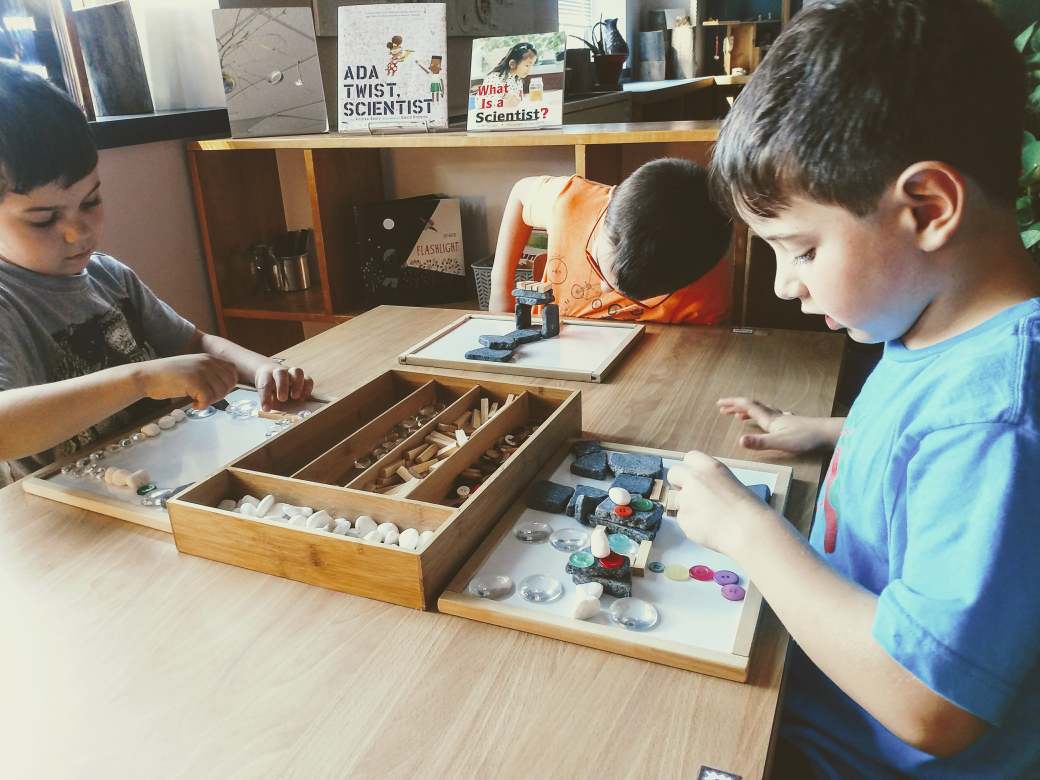
Many of the children have been interested in small building, constructing various designs and structures using a variety of small materials. Following their building, I have asked children to draw their work. Each structure, each piece, has a purpose and a story. The sharing and talking about their work as well as the drawing of their work provides layers of literacy embedded in their experience.

KC and TW eagerly chose to label their drawings. For KC, he stretched out the word s-u-n, hearing each letter in the word. TW had built a bridge, excitedly drawing his creation. Following his drawing, he asked peers how he could write the word bridge. His peers quickly and eagerly rose to occasion, showing him the word bridge on our morning message and in our read aloud from earlier in the afternoon, The Three Billy Goats Gruff.


KC and TW draw and record their structures.
Representing their designs in two different ways -
a physical structure and a labeled drawing.


"It's a space ship, see? This little piece of wood in the middle blasts off. There is goes! Look at all of the buttons. Now I have to draw it" - ZM

fall art

Many of our read alouds in the recent days and weeks have provided a connection to Fall. With a small Fall "still life" along with the stories on display, children have had opportunities to represent their thoughts, ideas, and feelings regarding our current season. We've talked about the colors of Fall and observations we've made in the natural world. We've talked about what is happening to the leaves outside. On Friday, the children read sentences about leaves on the Morning Message in preparation for our read aloud, Red Leaf, Yellow Leaf.

Later during choice, some children chose to use our newest classroom medium - stamps. With a collection of leaf stamps and our special black pens, I modeled how to use the stamps. We talked about how you carefully align the stamp with the ink pad, apply pressure with your palm, and then transfer the ink to paper. I offered the pens as an additional tool to help add detail to their work. We talked about how artists add detail and one way to add detail is to outline. An outline goes around a shape or design. An outline draws attention, it encourages the audience to look. An outline is also another way to explore and practice writing and drawing different kinds of lines.


In the two pictures below, AM uses colors representative of the colors we find in the natural world to depict leaves and chinese lanterns. Her use of arrows throughout her piece invite her audience to take a closer look at the important details. Looking at her work this weekend, I will check in with AM on Monday and ask her about the arrows - is she interested in writing labels? Do the arrows serve a different purpose? What is the story behind her illustrations and marks?


letter work in multiple ways

Some of the children's work recognizing, learning, and writing letters and common words is through Fundations - a highly structured program designed to provide necessary foundational skills in literacy. As with many programs, there are useful parts. I find the consistency and predictability of the program essential - the continued reminder of always starting at the top and the use of specific lines to guide letters.

You may hear your child talk about these lines;

The Sky Line
The Plane Line
The Grass Line
The Worm Line

In Kindergarten we focus much of our letter work on recognizing and writing lower case letters. For example, the letter t starts at the sky line and is a straight line down to the grass line. You then make one short line across at the plane line. 

Fundations is language based. For some children, the use of visuals is more supportive, allowing for less language to be used. As with any program, it is not the only way to learn and should be one part of many different learning opportunities! I find that our most authentic and meaningful learning occurs throughout the day - finding letters or words we know in the morning message, recognizing letters in our favorite books, building letters out of blocks, making letter shapes with our bodies outside, finding letters in nature, painting letters...there are many ways to thoughtfully explore letters! This kind of learning is naturally differentiated - one child may hear the letter sound t in the word today and their peer may connect to their noticing by sharing that they hear the word day in the word today. While Fundations may be used to help provide foundational literacy skills, it is only one way to develop essential and meaningful skills and knowledge.


Writing letters on white boards - part of the experience is following directions. Keeping your work space organized, listening for the letter name or sound, practicing following the specific lines, and then stacking materials as part of the clean up transition.


This week, the Kindergarteners worked on letter books based on the letters we've been investigating. In the books, children traced the letter and added detail to the drawing. As with all of our experience, we ended with a share. For one share, children read their book to a peer  - following the children's interest in talking about the books, I introduced the idea of a partner share!

For another share, CM read her letter book to the class - pointing to each letter and word as she read.


During choice, many children built letters with blocks and wooden rods. Throughout the afternoon I heard, we're building t's! This is an example of an authentic exploration and construction of letters - coming from the children's interest and curiosity.


Reading the morning message is a rich time for children to find, point, and read letters and words they know - or to point to words they are wondering about! We share noticings, clap the parts in words, and count how many letters. It is again a time for building foundational skills in an engaging and meaningful way.


Following the children's interest and love for dot art, I offered dot letters as a choice on Friday morning. Children noticed the shape of the upper case letters, counted how many dots, and made patterns. I used the three letters we've been investigating this week, but some children were interested in making dot letters for their name. I offered them the collection of letters - a large pile for them to sort through and find the letters in their name.