Friday, March 23, 2018

revisiting self portraits


The children have been working hard on preparing for their student-led conferences. As part of this work, they revisited their self-portraits from the Fall. We talked about how their drawing and illustrating skills have developed - and how much older everyone looks!

Connecting our work to Kristen's Spanish Class, we learned about the female painter Frida Kahlo. Frida celebrated her Mexican heritage through her many self-portraits. With Kristen, the children made colorful paper flowers to hang in our room. Each unique flower now frames their displayed work. 

On Monday, we read the book Frida Kahlo and her Animalitos. We learned about the many different animals Frida loved and lived with. She often included these special animals in her portraits. The Kindergartens planned, developed, and painted their self-portraits - inspired by Frida's colorful art and our shared love for animals!


Kindergarteners use mirrors to examine their features closely before representing their self with black sharpie. Their faces are a collection of various shapes and lines. 

Kindergarteners think, plan, and draw a loved pet or animal to include with their portraits. Water colors bring their pet portraits to life!


Sunday, March 18, 2018

how to books

The Kindergarteners work together to use words in our classroom and our word library to help guide their writing. An important part of literacy growth is the ability for children to apply their developing skills and strategies independently - and consistently. In our classroom we celebrate the many ways the children have to solve problems on their own. We all get stuck at different times in the day, but when a child is comfortable, confident, and self-directed they are able to access the introduced and modeled tools. Again, the learning environment offers a vital teaching support.


Below is a collection of informational texts from a recent writing assessment. The Kindergarteners were asked to plan, write, and publish one piece of writing independently. We reviewed what we know about informational writing before and a few of the children were asked to walk around the room and point out where their peers can go if they get stuck. While we must celebrate the children's growth as literary artists - ensuring we understand the art of writing beyond the 45 minute block in our day - it was exciting to observe as children eagerly embraced the task at hand. Some chose a topic they had previously written about, essentially using a second draft as their assessment piece. Some of the Kindergarteners chose a new topic, while many continued to write about caring for their beloved family pets. Enjoy this small collection of conventional writing, but keep in mind the importance of authentic and meaningful writing occurring throughout each day!

Some teaching points for the children moving forward; use the word library to check your sight words, think about more information you can share with your readers, use details (labels, pictures, words) to teach all that you know! For example; How much kibble does a bunny need, how do you give it to a bunny, does a bunny need water? 


How To Read

By - Keith

1. First you need a book. Then you need words.
2. You read the book. If you can't read the book, you use your powers. You have picture power and sound power.
3. If those powers don't work, use persistence power.
4. Then you can read. Yay!


All About Baseball

By - Owen

1. Baseball is a sport.
2. There are different teams.
3. You need a suit, too.
4. That is all about baseball.


How To Feed a Bunny

By - David

1. Kibble.
2. Then you need vegetables.
3. Grass.
4. Happy Bunny!


Saturday, March 17, 2018

developing readers

As shared in previous posts, the children are literary artists; developing foundational phonological skills and strategies for decoding and encoding text through their active engagement with their peers and learning environment. Our conversations, shares, and reflections provide opportunities for children to orally explain their thinking and connect. These experiences support the development of essential speech and language skills - supporting their growth as readers.

Reading workshop does not make a reader - a reader is engaged in an ongoing process of meaning making and discovery. The child as a reader engages with symbols in their environment, sings songs and explores the rhythm of language, makes signs for their classroom and draws pictures of their family. The child as a reader is a group of five and six year olds gathered on the rug, a big book in the middle. The child as a reader is a community of children excitedly circling all of the vowels in their morning message. The child as a reader is using their understanding of language to plan how to construct trap doors and space shuttles out of magna-tiles, working collaboratively with their peers.

The child is continuously growing as a reader.


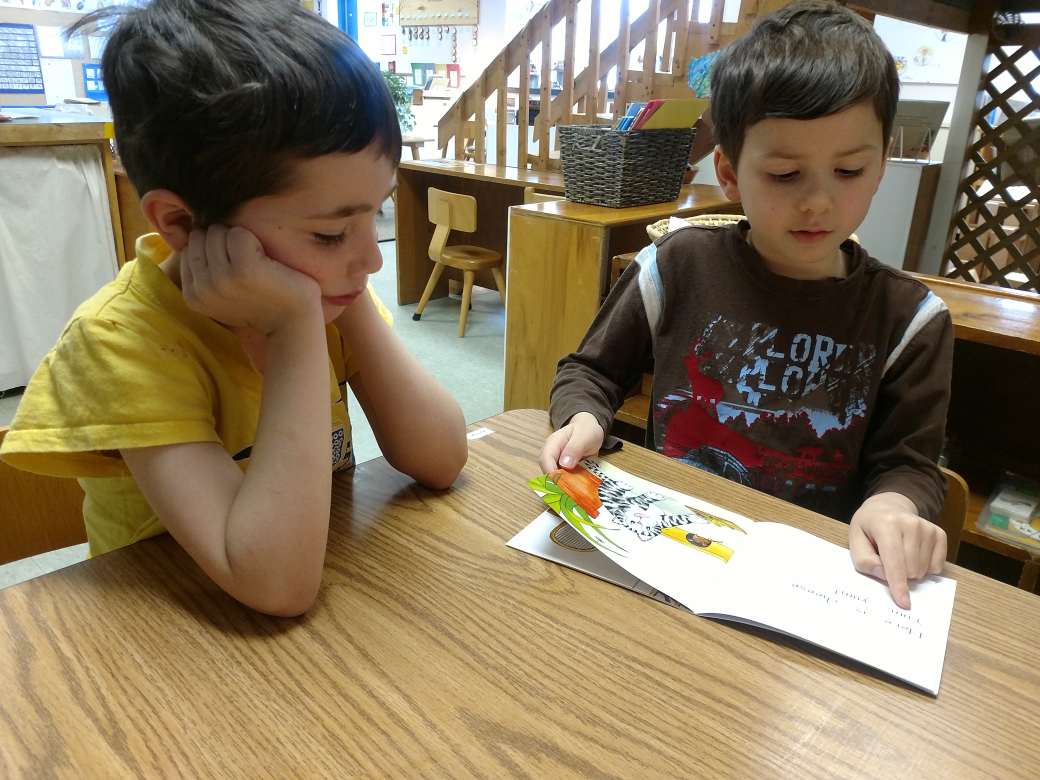
One way we grow in our classroom, is through ongoing engagement and collaboration with peers; opportunities to talk, read, create, disagree, and play. In the below photographs, the Kindergarteners share a favorite book with a partner engaging in important book talk. While it is cause for celebration to see the children using reading strategies and hear partners helping and supporting one another, it is their conversations and rituals I am most intrigued by.

Conversations and Connections

On this particular day, I hear one partnership laugh over the pictures in their book about two dogs.

"Oh, look at this one - I think that's LuLu, yeah, that's LuLu - she is so cute!"
"I like LuLu best, my dog looks like that"
"Mine doesn't, she's yellow, well yellowish and goldish"

Rituals

Another partnership has finished sharing their books with one another, again, I hear laughter as they flip their books to the back cover. I watch as their pointer fingers move to the bottom of the back cover. Each child points to and reads the letters and numbers found in the ISBN. I ask them about it.

"When we are done reading together, for fun, we do this thing. We read the little letters and numbers on the back of our books. It's never the same!"
"Yeah, it's really fun. It's kind of like a game"


Taking Initiative

The children are growing - and feeling empowered - as readers through the exciting and important job of guiding the choral reading of our morning message.


As the children engage with more and more books, their library of words continues to grow. Taking initiative of their growing libraries, the children add words to a ring, highlighting and carefully printing their own sight words.


Rhyme Time

Our morning message work continues to support children in the development of phonological awareness skills, such as rhyming. On Tuesday morning the Kindergarteners took turns reading and building rhyming puzzles. We know that words can end the same or rhyme, but the challenge was recognizing a rhyming word when the ending looked different.

For example, when rhyming with the word shoe we talked about short and long vowels. The children noticed that statue and glue have a long vowel - a vowel sounding like its name - even though shoe sounds the same at the end, it doesn't have a u. There was a shared excitement and wonder about language during this experience. The act of putting the pieces of the puzzle together required important hand-eye coordination and fine motor skills.